The Robot-Built Home: How Modular Tech is Disrupting the Construction Industry
📌 Discover how industrial robots and smart factories are revolutionizing home construction, moving from manual labor to precision-engineered modular hou
"How far has our technology actually come?"
While tracking the latest breakthroughs in AI and robotics, I stumbled upon a development that is as fascinating as it is disruptive. We are used to seeing massive, multi-axis industrial robots on the assembly lines of semiconductor plants or cutting-edge EV factories. Now, those same machines are inside factories, precision-cutting timber and driving nails to manufacture entire, livable homes from the ground up.
For thousands of years, home construction has been a bastion of inefficiency—a labor-intensive process dependent on the human touch, exposed to the elements, and dragging on for months. But as this chaotic, complex process moves from the job site to the controlled environment of a smart factory, the physical limitations of space and the constraints of construction timelines are being completely dismantled.
Driven by curiosity, I dove into the domestic tech landscape and discovered 'Space Factory,' a company that has built one of Asia’s largest (6,000-pyeong) automated timber housing production facilities. As a tech analyst, I investigated the mechanics of their robotic smart factory, and I’d like to share the technical marvels I found and my insights on the future of residential living.
Q. Why is the world moving from 'On-Site Construction' to 'Off-Site Construction' (OSC)?
💡 Executive Summary: The industry's chronic issues—weather variables, a shortage of skilled labor, skyrocketing costs, and inconsistent quality—are being solved by Off-Site Construction (OSC), where over 80% of a home is manufactured in a factory.
My first question was: "Why build a house in a factory and ship it on a truck instead of building it on the land?" But a quick look at the reality of traditional construction makes the necessity clear:
- The Endless Battle with Weather: On-site construction is at the mercy of the elements. Rain rots or warps timber, freezing temperatures halt concrete work, and heatwaves stop workers in their tracks. It is common for weather to delay projects by months.
- Uncontrollable Labor Costs and Skill Gaps: Finding skilled carpenters is increasingly difficult, and their daily wages and overhead costs are ballooning. Furthermore, human error—such as gaps in insulation or misaligned levels—is inevitable depending on the worker's condition on any given day.
- A Paradigm Shift: Conversely, robotic construction takes place in a climate-controlled factory. By assembling homes like precision components in a clean environment, we can guarantee the same uniform quality and delivery timelines we expect from automotive manufacturing.
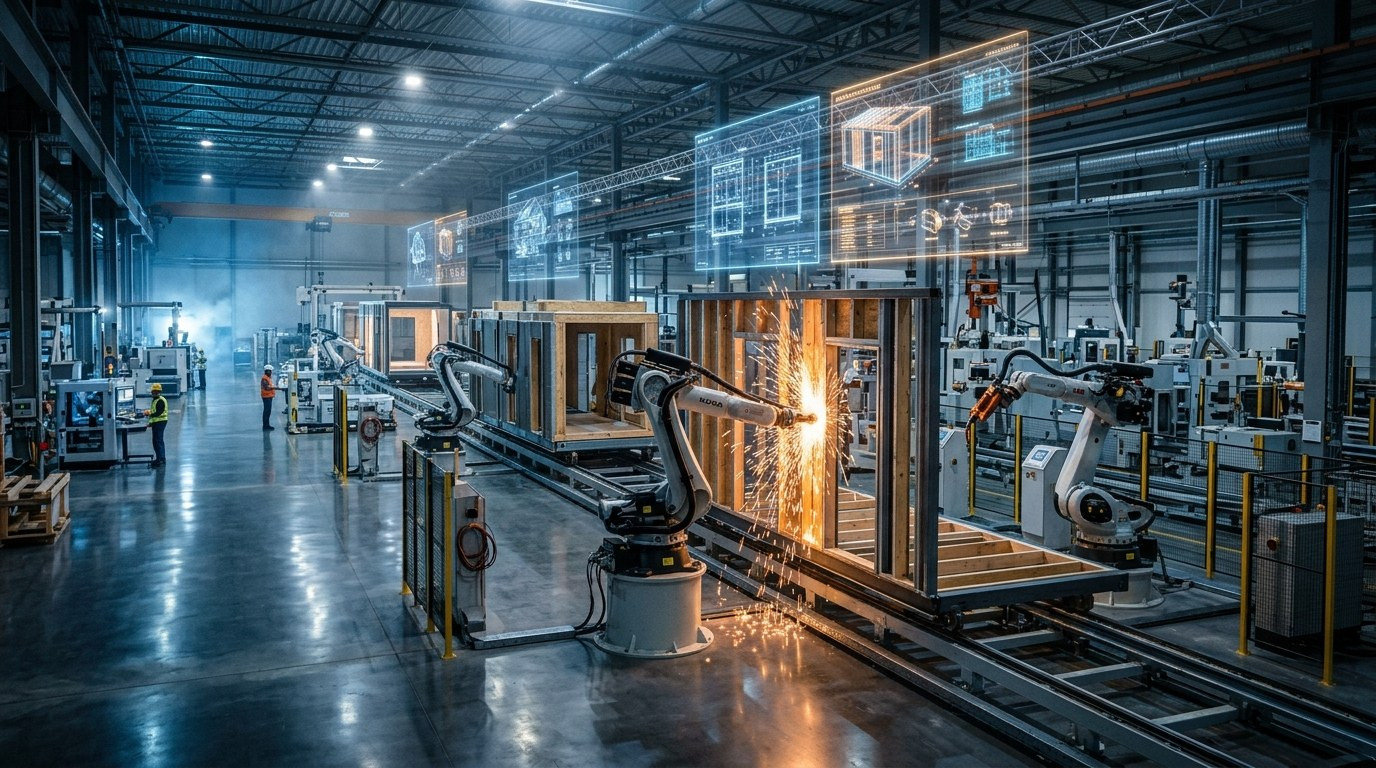
Q. Key Technologies Behind the 'Space Factory' Robotic Plant
💡 Executive Summary: Located in Hwaseong, Gyeonggi-do, this 6,000-pyeong facility operates 24/7 using fully automated timber processing robots from Germany’s WEINMANN—the same caliber of technology used to manufacture BMW and Mercedes-Benz chassis.
My assumption that this would be a simple machine-assisted shop was completely wrong. The Space Factory smart factory is essentially a massive, high-precision IT device manufacturing plant.
1. From Blueprints to 3D BIM Data
Architectural 3D BIM (Building Information Modeling) data is transmitted directly to the WEINMANN robots in under a second. There is no need for manual measuring or sawing; the robots read 3D coordinates to cut, mill, and drill timber with 0.1mm precision.
2. Automated Nailing Bridges
One of the most impressive processes is the multi-functional processing bridge. After a robot arm places structural plywood (OSB) onto the studs, it drives high-speed staples at perfectly calculated intervals and consistent pressure. The inconsistencies in nail depth or alignment common in manual labor are non-existent here.
3. 'Butterfly Turning Tables' for Multi-Ton Walls
Once one side of a wall is finished, a hydraulic butterfly table lifts the multi-ton structure, flips it 180 degrees, and places it back down. This allows workers to install eco-friendly high-density insulation and precision-embed electrical wiring and plumbing in a comfortable, ergonomic environment.
This entire process, moving like clockwork on a conveyor line, is capable of mass-producing 1,700 homes per year.
📋 [Traditional On-Site Timber Construction vs. Robotic Modular Construction]
| Comparison | Traditional On-Site Method | Robotic Smart Factory (OSC) | Tech Perspective |
|---|---|---|---|
| Environment | 100% exposed to rain, snow, dust | 100% Climate-Controlled Factory | Prevents moisture, mold, and warping |
| Execution | Manual labor and human skill | German WEINMANN Multi-axis Robots | 0.1mm precision, uniform pressure |
| Timeline | 3 to 6 months on-site | Factory: 2-3 weeks + On-site: 2-3 days | 50%+ reduction in total time |
| Cost Structure | Variable labor, lodging, overhead | 60% reduction in indirect costs | Transparent, rational pricing |
| Insulation | High risk of gaps and thermal bridges | Precision-pressed factory assembly | Passive house-level energy efficiency |
| Community | Noise, dust, and construction waste | Zero waste, minimal site disruption | Eliminates neighbor complaints |
Q. The Future of 'Plug-and-Play' Living
💡 Executive Summary: Seeing a home arrive with Samsung SmartThings IoT and Bespoke appliances pre-installed made me realize that a house is no longer a static piece of real estate, but an 'upgradable smart device.'
Another highlight was the collaboration with Samsung Electronics on modular AI homes. In the past, you’d finish a house, then break walls to install AC piping, call technicians for appliances, and struggle to set up home IoT. Here, the home is manufactured with Samsung system air conditioning, heat pumps, Bespoke refrigerators, and smart lighting/cameras pre-embedded and pre-registered before it even leaves the factory.
Whether it’s a 10-pyeong second home or a 40-pyeong villa, you can select your home like an online shopping item. Once the foundation is ready, the module is shipped, assembled by crane in 2-3 days, and plugged into the grid. It’s a powerful symbol that the constraints of space and time—the idea that a house must be a years-long, painful project—are being shattered by technology.
💡 The Tech Analyst's Take: What Robotic Construction Means for Us
The old saying, "Building a house will age you by 10 years," has long been a painful reality for those dreaming of a custom home. Opaque quotes, delays, legal disputes, and post-occupancy defects have been a heavy burden.
However, as robotics and smart factories integrate into the conservative construction sector, we are entering an era where we can "order a home with the same price transparency and quality standards as buying a car."
The Space Factory case is more than just a success story for a single company; it is a showcase of how technology can make our most basic human necessity—shelter—safer, more economical, and more comfortable. I look forward to the day when robotic construction matures further, allowing more people to enjoy their own sturdy, warm homes without the traditional barriers of cost and location.
#RoboticConstruction #SmartFactory #ModularHousing #SpaceFactory #FutureTech #Prefab #TimberConstruction #ConstructionTech #TechTrends #HousingInnovation


Comments
Post a Comment