Intel’s Counterattack: How the D270 GPU Aims to Define the Agentic AI Era
📌 Intel's new D270 GPU targets the agentic AI bottleneck with 480GB memory and air-cooled efficiency, challenging the status quo of data center infrastr
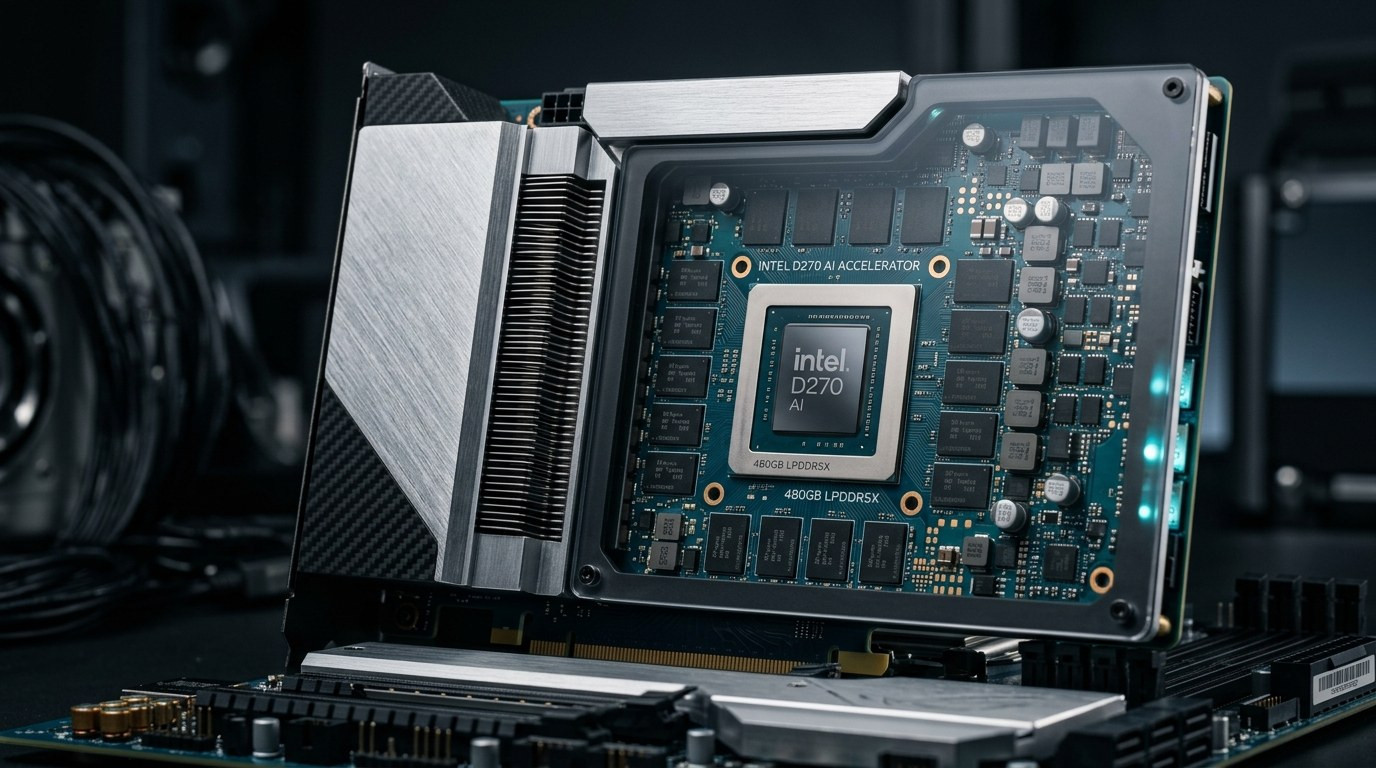
Data center workloads are shifting rapidly. We are moving beyond simple text generation into the era of 'Agentic AI'—systems capable of complex, multi-step reasoning and processing massive, long-context windows. Intel’s newly unveiled Intel® GPU D270 is an inference-optimized accelerator designed specifically to clear the bottlenecks of this new era. This analysis dives into the technical solutions the D270 offers and its impact on the economic efficiency of data center infrastructure.
Q. The Agentic AI Era: Why Existing GPU Infrastructure Falls Short
Agentic AI requires thousands of sequential reasoning steps and the ability to process long contexts exceeding 100K tokens. In this environment, memory bandwidth and capacity—rather than raw compute—have become the primary determinants of performance.
- Shift in Compute Patterns: Agentic AI is read-heavy rather than write-heavy. The 'prefill' stage, which requires keeping both the model and the long context resident in memory, places an extreme load on the system.
- The Problem with Current Approaches: High-end GPUs based on High Bandwidth Memory (HBM) are often cost-inefficient, requiring massive capital expenditure for power delivery and specialized cooling infrastructure.
- Intel’s Solution: The D270 strips away graphics and ray-tracing pipelines, reallocating that silicon area to Xᵉ3P cores and XMX engines to maximize inference efficiency.
Q. Intel GPU D270: Hardware Specs and Operational Efficiency
The Intel GPU D270 is designed to handle large-scale context processing without the need for expensive HBM, with its greatest strength being its compatibility with existing air-cooled server infrastructure.
Intel GPU D270 Key Technical Specifications
| Category | Detailed Specification |
|---|---|
| Memory | Up to 480GB LPDDR5X |
| Compute Cores | 32 Xᵉ3P Cores |
| Matrix Engines | 256 XMX (Xᵉ3P Matrix Engines) |
| Power Consumption | 350W (Air-cooled) |
| Interface | PCIe 5.0 (Standard Server Compatible) |
- Economic Advantages: Because it operates within existing air-cooled rack environments without requiring liquid cooling, it minimizes infrastructure transition costs.
- Open Ecosystem: It offers full support for industry-standard frameworks like vLLM and PyTorch, providing flexibility that avoids lock-in to proprietary software stacks.
Q. Why the Developer Community is Focused on AI Accelerator Infrastructure
The AI industry is currently in a state of complex tension, characterized by cracks in Nvidia’s market dominance, coupled with rising concerns over the safety and regulation of high-performance AI models.
- Supply Chain and Geopolitical Risks: With U.S. government export restrictions on high-end AI chips (such as the H20) to China, global data center operators are desperate for alternative hardware and cost-optimization strategies.
- The 'AI Slowdown' and Infrastructure Efficiency: International movements like 'PauseAI' are demanding safer development practices. Simultaneously, companies are focusing on 'efficient token serving' to maintain high-margin API business models while lowering inference costs.
- The Limits of Hardware Optimization: Over the last decade, GPU performance has improved exponentially through GEMM (General Matrix Multiply) optimization. However, we have reached a point where architectural innovation alone is no longer enough. This is why 'workload-specific' designs like the Intel D270 are emerging as the next-generation alternative.
Q. Conclusion: What the Intel D270 Means for the Future of Data Centers
The Intel GPU D270 is not just about boosting raw compute; it is aimed at delivering 'practical AI infrastructure.' By utilizing 480GB of high-capacity memory to process larger contexts while adhering to standard PCIe 5.0 specifications and a 350W air-cooled design, Intel is tackling the power and cooling cost crisis head-on. For enterprises looking to move away from expensive, GPU-centric infrastructure to deploy high-performance Agentic AI in general-purpose server environments, the D270 represents a compelling new choice.
#Intel #GPU #D270 #AgenticAI #DataCenter #AIAccelerator #Semiconductor #InferenceOptimization #AIInfrastructure


Comments
Post a Comment